
by Dean Prigelmeier, President of Proactive Technologies, Inc. ®.
Suddenly faced with the tremendous challenges of World War II, the US had no choice but to retool the manufacturing sector of the economy to build the needed materials of war. One major obstacle: many of the men working in the factories either enlisted themselves or were drafted into the war. The only solution was to seek out nontraditional workers to fill those roles.
No one ever said “we just can’t find the skilled workers we need.“ They just went to work rounding up anyone who was willing to work in manufacturing including women who, until then, were rarely seen on a factory floor. But how were these completely unskilled workers going to be fit to run the equipment and perform the processes they, and their employers, have never seen before? After all, these were weapons of war. Sloppiness in production and discrepant quality of output was not acceptable.
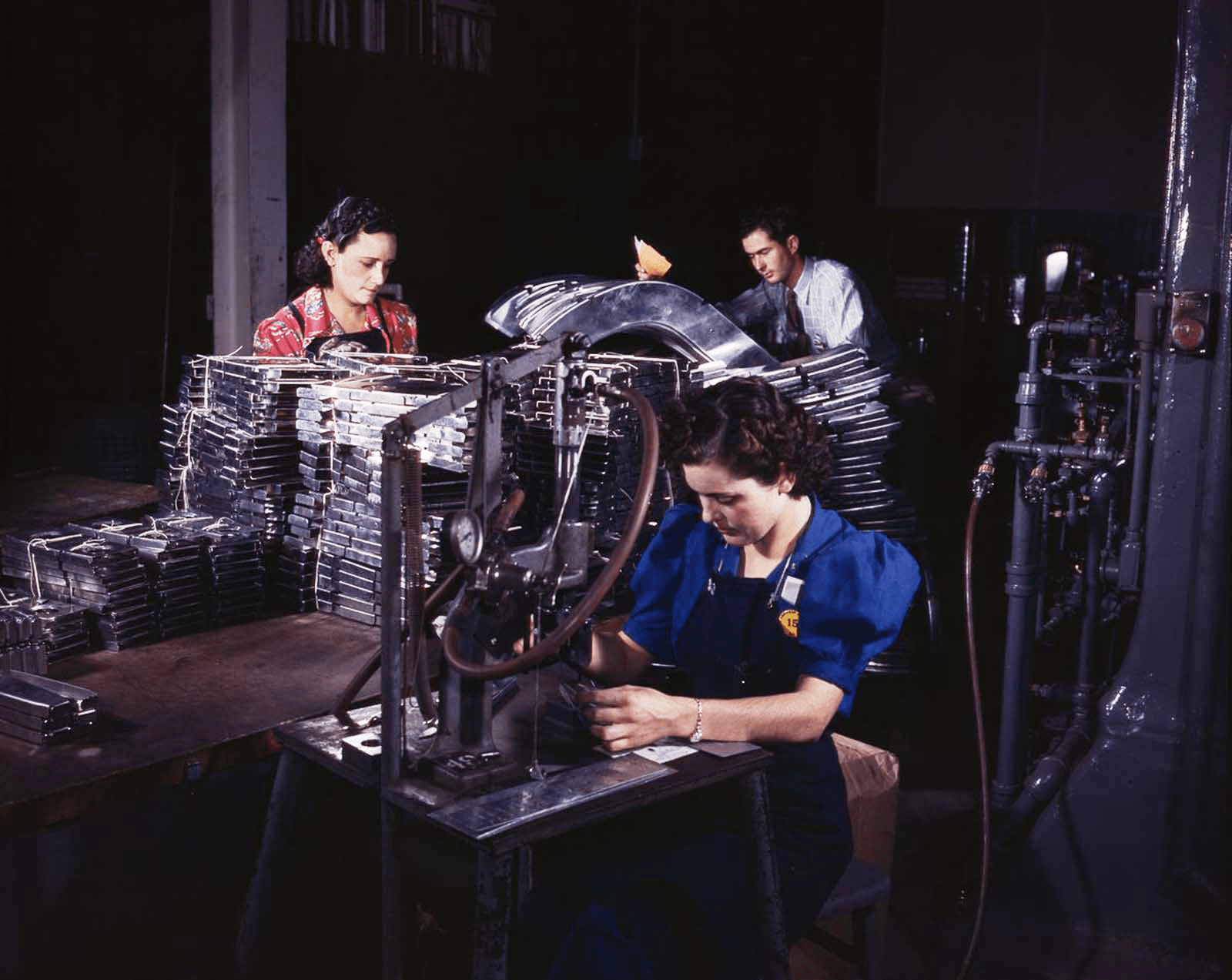
Workers feed sections of sheet metal through a pneumatic numbering machine at the North American Aviation plant in Inglewood, California. 1942.
Automobile manufacturers, and their suppliers, retooled to make tanks and airplanes, consumer product manufacturers refocused to make the necessities of war. They were paving new paths and innovation was the norm. Without knowing entirely where that was leading, they were also faced with plugging people into positions needed filling. While defining the work they needed done, they needed to train workers to perform that work – a monumental challenge as any rapidly expanding and innovating employer of today is familiar.
After a bumpy start with numerous unwarranted candidate disqualifications and new-hires not sticking around due to the insecurity and intimidation felt when exposed to work unknown to them, the Department of War came up with something called “Training Within Industry.” It was forcing a very deliberate approach to training workers, using the few remaining subject matter experts to rapidly transfer expertise to new-hires so that they could confidently and correctly perform the required tasks. Employers became keenly aware that on-the-job training was significantly different than the common forms of learning offered in educational settings. The techniques that emerged trained workers where the best practices required for performance were needed. Armed forces technicians also had to be trained for field maintenance and repairs, so expert trainers and training materials were needed.
The Department of War, Federal Security Agency, Office of Education developed and proliferated training materials on industry training best practices. In one such video entitled “Problems in Supervision – Instructing the Worker On The Job,” they simply explained the challenges faced in training workers to perform process-based tasks, the pitfalls in not doing it well, the benefits in doing it right – a simple remedy to ensure complete, consistent and successful results.
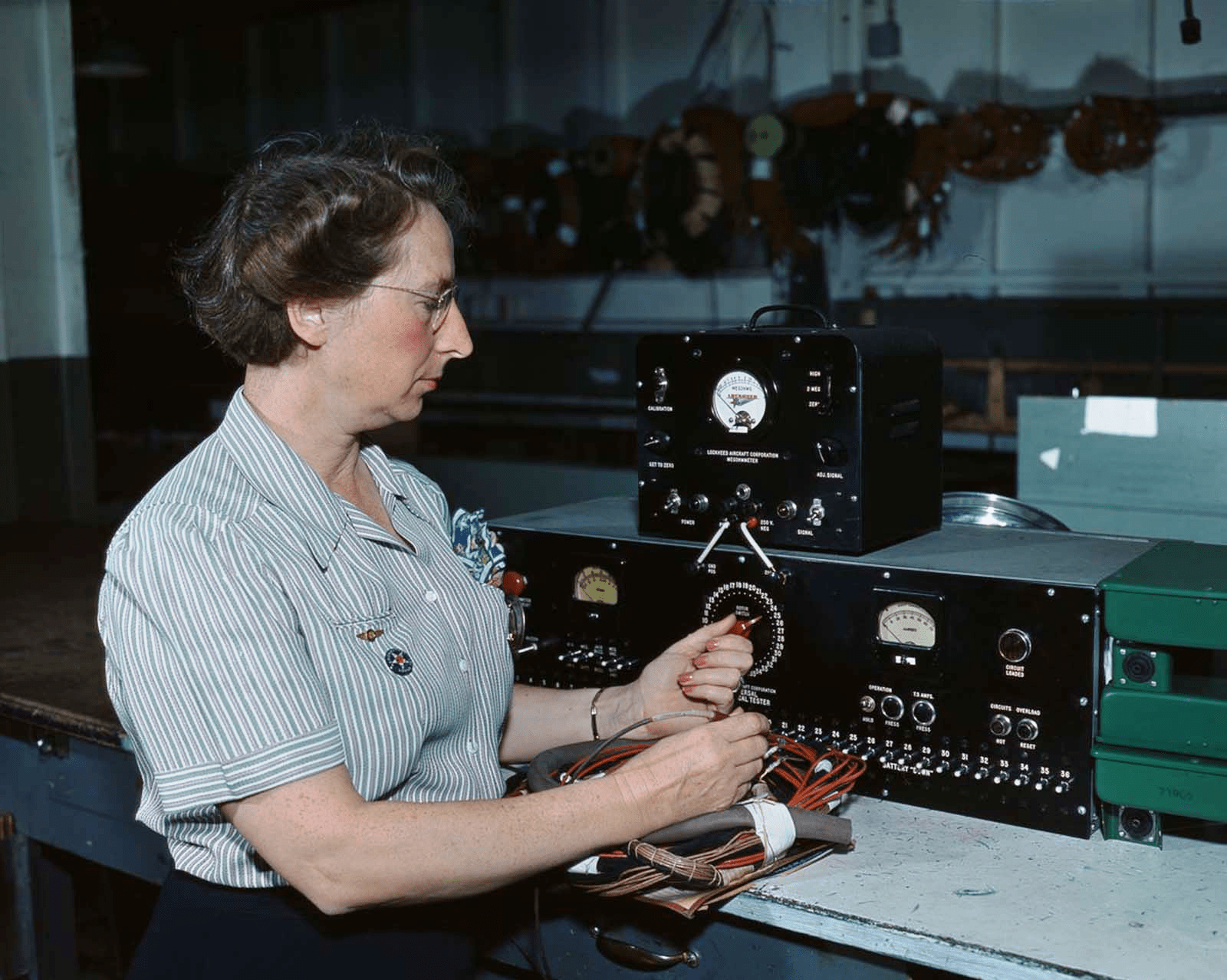
An employee of Douglas Aircraft Company works with electrical wiring at the plant in Long Beach, California. 1942. – Source Rare Historical Photos
In watching the short video, one gets the distinct impression that the challenges haven’t changed much since 1944, but the application of this proven solution has disappeared from the landscape. When watching the video today, one can only conclude what a simple, common sense and practical solution re-enforcing the on-the-job training process was/is and that employers have regressed in their commitment to developing expert workers.
While under the immediate pressure of war, employers learned very fast what they were dealing with. These companies were run by people that understood this type of unique factory work involved unique processes, often on unique equipment, in a setting these new hires had never known. Now all of that was changing and the more deliberate approach was vital if training was going to be effective. Every worker walking through the door had to be given a serious chance to be trained properly and completely.
How The Structured Worker Training Process’ Faded After Proving Its Success and Value
The notion that “we just can’t find the skill workers we need“ wasn’t an option then and excessive profitability by manufacturers was discouraged. “We just can’t find the skill workers we need“ was a manifestation of the 1980s, a pretext to provide cover to employers in preparation for trade agreements, such as NAFTA and China Most Favored Nation Status that were encouraging employers to move their operations to low-wage labor markets and import foreign workers that were willing to work at a lesser wage. Trained, experienced workers were let go before anyone captured their expertise. Some were made to train their replacements but not given the quality time to do it. The priority of deliberately and completely developing US skilled workers faded into history. This was also the time when worker loyalty was discouraged by employers and the media; that employees shouldn’t think of jobs as a lifetime career, but rather in 2-3 year spans of employment.
Complicating things, the notion of learning and training started to become confusing with the first introductions of computers in the 1980’s, with the robust promotion of it as the solution to everything. Classrooms were to become a thing of the past, learning (by that wrongly implying training as well) would be on-demand, books would be obsolete, etc. Who had the expertise to develop the knowledge base was not determined. How it was supposed to replace the transfer of technical, task-based expertise was left for others to discover. Later, virtual reality was expected to become the newest replacement for the classroom learning and hard-skill training, which it did not.
“Skilled worker” became a conflated term, but getting traction and becoming increasingly popular ever since. In order for a worker to become “skilled,” a candidate with the relevant core, general and possibly industry-specific skills plus any transferable skills gained from previous employment – inevitably missing in low-wage labor markets where industry hasn’t developed yet – is hired and trained by the employer’s resident experts to apply those prerequisites in the performance of tasks for the employer. To do it right, the worker has to be shown how to perform the task by a “subject matter expert,” supervised during repeated performance until deemed to have “mastered the task” in order to be classified as “skilled.” This applies to each task for which the employee was hired, eventually reaching a level of “job mastery.” During WWII, the urgency of the war effort allowed very little-to-no time to assess, remediate and develop prerequisite candidate skill bases, so employers relied predominately on deliberate on-the-job training which successfully delivered the skilled workers faster and with certainty.
As new trade agreements were developed that accelerated this offshoring of jobs/insourcing of workers trend, employers kept emphasizing they did this out of necessity because the “US lacked of skilled workers that they needed” – hard to swallow, since they had even greater challenges training workers in even more under-developed countries who were all blank slates.

An electronics technician at the Goodyear Aircraft Corporation in Akron, Ohio. 1941
In the interim, the US government had to do something about all of the remaining US skilled labor growing restless, who were now and going to be displaced. They expanded the deflection. The No Child Left Behind Act of 2001 poured money into educational institutions to deemphasize and defund high school trade training programs (usually a 2 1/2- year program in an industry-recognized skill area such as drafting, electronics, machining, woodworking and auto repair – leading to a Vocational Certificate) and emphasize, instead, preparation for college. After a two decades of veering further away from developing labor force candidates that appealed to industry, the emphasis has now shifted back with STEM and STEAM programs, which fall way short of the vocational programs abandoned in the 2000’s.
Education still wanted to help “train” workers for emerging jobs and “retrain” displaced workers. The problem came when education started marketing their courses as “training” instead of “learning,” the confusion over which is something that lingers as a barrier to improving workforce development. Educational institutions were designed to impart to students knowledge through learning , who could then take that knowledge to the employer for further development through training. Creative institutions that invest heavily in “industry training centers” find their relevancy fade as fast as their equipment becomes obsolete and currently experienced instructors difficult to find.
Building graduates with strong core knowledge and skill bases is what education has always done best. Under pressure from politicians to answer the call of “we just can’t find the skilled workers we need,” they started to repackage and rebrand their inventory. Even creating “apprenticeships” and certificates from previously offered 2-year Associates programs without the need of an employer-based training component. Still, students continue to graduate in the hope of snagging one of those illusive jobs. A lot can happen in two years to dash the dreams of even the most sincere and deserving job candidates.
These “new jobs” appear only briefly as more jobs disappear. Workers that wanted to work are left to fight a losing battle and incur heavy educational debt pursuing a degree for jobs that moved off-shore before they could finish. Or they were unfairly forced to compete for the jobs with a visa waiver program that allowed employers to import workers willing to work for half the pay and less benefits. Still, these imported workers require employer-based training to become recognizably skilled, and a remaining skilled worker (on the pink slip list) usually has to train them.
This pretext continues today.as private equity firms and hedge funds – with no experience in worker training nor interest – have increasingly stigmatized workers as “costs“ to be contained and reduced (not investments to cultivate, maximize and maintain), driving down wages and benefits and staffing levels, to the delight of shareholders who gain in share price. Business talk shows and politicians aligned with these trade policies echo benefits of this, seemingly giving it credibility. Business “experts” with much to gain or lose from changes in the status quo try to rationalize the growing disparity desperate US workers experience and try to calm the unrest. Potential workers are indoctrinated to the belief that if they can’t secure a job, they must not be worthy – shifting the blame and guilt. Those workers still employed are left to perform tasks of the remaining jobs (usually with questionable training if at all). Unable to live on a single salary as wage stagnation for the last 40 years document, they end up taking 2 or 3 “gig” economy jobs which are low on wage, usually offer no benefits but are high on stressing the family and adding to community and society unrest. It defies logic that companies which invest millions of dollars in state-of-the-art machinery, exciting shareholders with the notion of increased output, productivity and profitability, rarely budget money and time to train the workers to run it and pay them for their increased value yet are surprised by not deriving the technology’s full potential.
Who Is In Charge of Employer-Based Worker Training?
During this transition from the 80s, experienced industry workers who often worked their way through the ranks to become human resource managers, often working in several positions to gain experience before reaching HR, were seen more and more with contempt by employers who were acquired. Being higher paid among managers, these HR managers were devalued of their expertise and experience (a clear company investment). They were either forced into early retirement or simply let go as private equity firms trimmed management who are at the highest pay level. Their replacements were individuals with less experience, often fresh out of college, who would work for less than half the pay. Generalists with little to no factory floor experience or exposure to how workers in industry are really trained, avoiding the issue as long as possible, instead directing the bulk of their time to endless recruitment for never-ending worker turnover.
Concurrently, educational institutions that offered human resource management degree programs equated “worker training” with the only emphasis they knew; classroom learning. There are very few, if any, colleges and universities left that include any semblance of informal on-the-job training in their curricula, let alone structured, deliberate on-the-job training in their course requirements. Consequently, today, HR managers and HR generalists in industries have little understanding of how technical task-based training is conducted and how to measure, improve, and report progress towards job mastery. Students, instead are taught learning concepts in courses designed by academics who only know and understand classroom curriculum development for classroom delivery, not where work takes place in factories. Many are taught that how to create a presentation, keep class attendance records and teach “train-the-trainer” for the classroom covers “industry training.” Exhibiting a “if all you know is a hammer, everything looks like a nail” mindset, they tend to assess post-hire worker performance for the subjective core skills meant to be assessed at new-hire, such as “blueprint reading,,” “time management” and “getting along with co-workers,” not objectively how well the worker performs tasks required of the job.
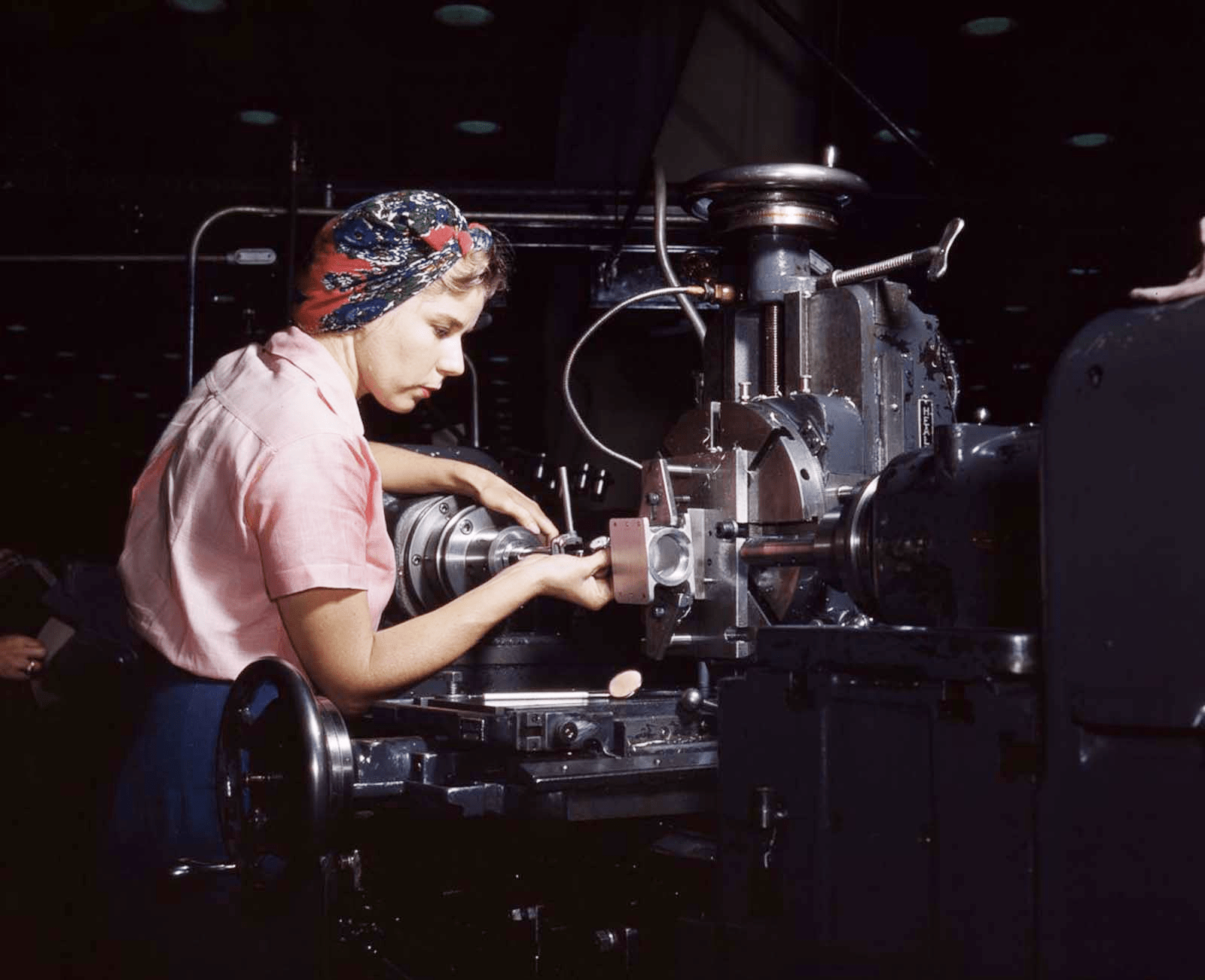
A machinist at work at the Douglas Aircraft Company plant in Long Beach, California. 1942. – Source Rare Historical Photos
The only degree programs that focus somewhat of relevant worker task-based training is a degree in Training and Development, a career requiring specialist wage rates and, therefore, unpopular with firms cutting their internal training staff and budgets. Few pursue this degree option for fear of graduating into irrelevance.
Seasoned local management and employees know better, they experienced what a lack of proper training can do. But employers – mostly the large ones and recently acquired mid-size ones – are directed to set their focus on short-term balance sheets. They hold fast to their “we just can’t find the skill workers we need” pretext as cover to why they don’t want to hire US workers and pay them properly. It has nothing to with the availability of candidates, it has everything to do with a perpetuated hoax on American workers, the curtain of which is being drawn back with every exposed contradiction.
Currently, Artificial Intelligence (AI) is being added to the deflection. It is being sold as the solution to everything, even with the original inventor’s warnings to the contrary and increasing incidences of AI bias, “slop” and hallucinations (i.e. when AI doesn’t have an answer it tends to make one up). With regard to industry task-based, process-based training, AI offers only a distraction. AI needs to learn from something before it can recall and recite it. If a firm hasn’t taken the time or lacks the inclination to develop perfect written processes, consolidating accurate processes with safety and quality standards, the knowledge-base is flawed from the beginning. Building on it can only lead to failures. And then there is the constant revision of processes to make them better. No one has explained how AI can handle ongoing revisions that cannot be lost or ignored, who will do it and what will it cost. AI works off of a knowledge base, and most employers feel uneasy about putting their trade secrets and proprietary information out for the world to see and copy. This leaves the question of how AI can help the task-based training delivery unanswered, but the money behind the push is ruthless.
Workers and potential workers are being bombarded by the message that they will be irrelevant if they do not include AI in their coursework or return to school and learn AI. The people saying this may be people with a vested interest in AI’s success or someone who thinks promoting AI is their ticket to greatness. What if this is another Wall Street “pump and dump” scheme that makes a few people massive amounts of money and adds to the losses of the rest? Remember the bubbles of the past; the Savings and Loan crisis of the 1980’s, the Dot.com crash of 2000, the Sub-prime Financial Crash of 2008 and all of the economic disruptions in between. Remember the hype to jump aboard and who paid the highest price by following these “expert’s” advice.
Both education and human resources, some willfully and some unwittingly, divorced themselves from how workers really become experts – through the commitment and quality of deliberate, structured and documented on-the-job training. Educational groups promoted solutions that seemed alien to employers, managers and employees, and created groups and conventions to echo the manufactured “proof” of their ideas (that only educators might buy). Decade after decade these ideas were repackaged as “new ideas.” Academics published papers to promote these recycled and rebranded ideas, then used as evidence in the lobbying of government for funds to implement their ideas to a disinterested market – giving life support to the “we can’t find the skilled workers we need” pretext for that moment – lasting 40 years.
Misinformed and inexperienced human resource managers (with more familiarity with educational practices than industry practices) embraced these “new” ideas to elevate themselves “ahead of the curve,” eager to promote their ideas at industry conferences to gain exposure that might benefit their career ambitions. There are more people that understand education-based solutions, so these seem to flourish and continue to be reposted. There is, also, safety and comfort in going with the herd; if things don’t pan out, it is hard to single anyone out. Running contrary to the herd, even with sound reasons that others can’t understand yet, takes courage. Ask any innovative entrepreneur.
The result: just like the parallel US economies, institutionalized parallel worker development worlds exist to this day, one world fiercely resistant to part with or modify their familiar assumptions that those with a lack of direct industry experience support. The other world focused on short-term balance sheets to which training workers lingers as a “cost.” A correction that leads both to a serious study of what worked in industry training during WWII becomes harder and harder to visualize, but not out of the question. In the meantime workers and the workforce suffer the consequences.
So that brings us back to the employers. Those that rightly (but lacking an understanding why) shy away from academic solutions to industry problems and whose investors lack the commitment to and “investment” in worker development to address perpetual challenges posed by lack of deliberate, documented structured on-the-job training. These employers routinely struggle with:
- high, costly turnover rates;
- entry-level workers needing more personal training attention, tying up existing experts;
- losing technical expertise with each retiree or separation;
- Wanting to provide incumbent workers with a credential documenting their rise to job mastery and full capacity –the opportunity to maximize a worker’s ROI and a great incentive for an employee’s self-improvement and to stay engaged;
- Wanting to add a truly employer-based, job classification-specific apprenticeship and internship component – registered or not – to your worker development strategy;

Rosie the Riveter (Westinghouse poster, 1942). – Source Rare Historical Photos
- Needing to beef-up worker documented compliance with safety, engineering, quality and ISO/IATF/AS or Nadcap;
- Struggling to find a way to do some or all of the above with tight budget, or no budget, constraints,

One solution can mitigate all of these problems:
- Employers, and their investors, have to get serious about their role in doing something they need to do and only they can do properly like that which successfully carried manufacturing through war.
- Employers struggle with their dual loyalties to shareholders, on the one hand, and employees, the community, society and the nation on the other. Priorities have to be realigned.
- Employers who value a strong consumer-base for their products and services produced by a loyal workforce.
- Employers should cherish their collective role in maintaining that equilibrium.
- Employers who are anal about collecting and keeping data on the rest of their operation, but rely on an ad hoc, haphazard, unstructured and undocumented (or non-existent training in worse cases) approach to worker training need to get serious and treat each worker like any other capital investment.
- Employers need to have their lobbyists direct the government to change the way trade agreements are negotiated, by including all size businesses, workers, unions and community leaders, seeking long-term stability for all not just lucrative outcomes for a few of the largest international business with little or no loyalty to local communities.
No one is suggesting investors have to give up much if anything, except perhaps trade excessive but unsustainable short-term profitability for long-term, stable profitability and sustainable growth by just realigning their priorities to reality.
We need to remember the lessons of WWII and the historical transformation of industry and its workforce when being led to believe training nearly every worker – with transferrable skills or not, traditional or non-traditional – is impossible or not worth the investment. Understand the motivation behind conflicting statements, speak out and just do the right thing anyway – even if you feel like in a world of your own.
If you recognize these challenges and have shed your fear of even looking for other solutions, check out Proactive Technologies’ structured on-the-job training system approach – based in the Department of Defense approach but modernized and proven for industry – to see how it might work at your firm, your family of facilities or your region. Contact a Proactive Technologies representative today to schedule a GoToMeeting videoconference briefing to your computer. This can be followed up with an onsite presentation for you and your colleagues. As always, onsite presentations as first contact are available as well.

 Proactive Technologies, Inc.®; PROTECH®; Human Resource Management for Tomorrow...Today!® and logo; PROTECH©® System of Managed Human Resource Development™; Accelerated Transfer of Expertise System™; Certificate of Job Mastery Program™, Certificate of Task Mastery Program™ are all trademarks of Proactive Technologies Inc.®;