
During WWII, US Transformed Manufacturing AND Its Workforce. “We Just Can’t Find the Skilled Workers We Need“ Wasn’t True Then Either and Not an Option.

by Dean Prigelmeier, President of Proactive Technologies, Inc.®
Suddenly faced with the tremendous challenges of World War II, the US had no choice but to retool the manufacturing sector of the economy to build the needed materials of war. One major obstacle; many of the men working in the factories either enlisted themselves or were drafted into the war. The only solution was to seek out nontraditional workers to fill those roles.
No one ever said “we just can’t find the skilled workers we need.“ They just went to work rounding up anyone who was willing to work in manufacturing including women who, until then, were rarely seen on a factory floor. But how were these completely unskilled workers going to be fit to run the equipment and perform the processes they, and their employers, have never seen before? After all, these were weapons of war. Sloppiness in production and discrepant quality of output was not acceptable.
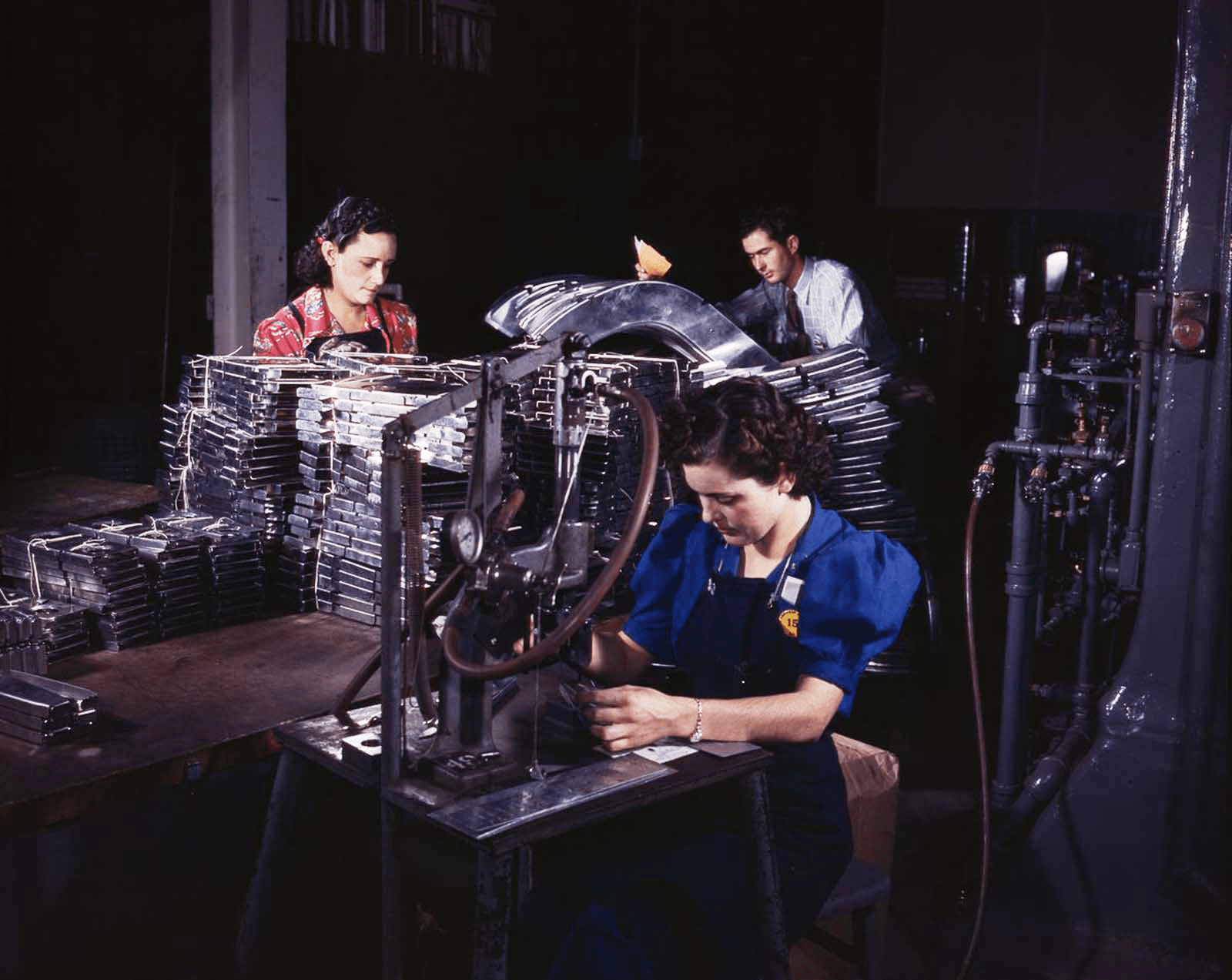
Workers feed sections of sheet metal through a pneumatic numbering machine at the North American Aviation plant in Inglewood, California. 1942. – Source Rare Historical Photos
Automobile manufacturers retooled to make tanks and airplanes, consumer product manufacturers refocused to make the necessities of war. They were paving new paths and innovation was the norm. Without knowing entirely where that was leading, they were also faced with plugging people into positions needed filling. While defining the work they needed done, they needed to train workers to perform that work – a monumental challenge as any rapidly expanding and innovating employer of today is familiar.
click here to expandAfter a bumpy start with numerous unwarranted candidate disqualifications and new-hires not sticking around due to the insecurity and intimidation felt when exposed to work unknown to them, the Department of War came up with something called “Training Within Industry.” It was forcing a very deliberate approach to training workers, using the few remaining subject matter experts to rapidly transfer expertise to new-hires so that they could confidently and correctly perform the required tasks. Employers became keenly aware that on-the-job training was significantly different than the common forms of learning offered in educational settings. The techniques that emerged trained workers where the best practices required for performance were needed.
The Department of War, Federal Security Agency, Office of Education developed and proliferated training materials on industry training best practices. In one such video entitled “Problems in Supervision – Instructing the Worker On The Job,” they simply explained the challenges faced in training workers to perform process-based tasks, the pitfalls in not doing it well, the benefits in doing it right – a simple remedy to ensure complete, consistent and successful results. Read More
The High Cost of Employee Turnover

by Stacey Lett, Director of Operations – Eastern U.S. – Proactive Technologies, Inc.®
Most companies are dealing with uncomfortably high levels of turnover. When one separates out those employers that facilitated high turnovers to lower labor costs, there are many reasons for this. However, there is no denying the many costs associated with this that exist and the effects that often compound. These costs are often unknown and unmeasured, but all employers should keep an eye on this challenge and explore its full impact on the organization.
It seems counter-intuitive, but there are some who even recently promoted a business strategy that encouraged employee turnover. In a July 21, 2015 Forbes article entitled “Rethinking Employee Turnover,” author Edward E. Lawler III, “Indeed, the turnover of some employees may end up saving an organization more money than it would cost to replace that employee. The obvious point is that not all turnover should be avoided—some should be sought.” The question is how to determine which ones to keep and which to encourage to leave. Without accurate measures of costs and values of a worker, good employees may be pushed out along with the “bad” and then the true costs of this action realized by the employer after it is too late.
Last year, Holly Bengfort of PeopleKeep wrote in her blog entitled “Employee Retention – The Real Cost of Losing an Employee,” “Happy employees help businesses thrive. Frequent voluntary turnover has a negative impact on employee morale, productivity, and company revenue. Recruiting and training a new employee requires staff time and money. According to the Bureau of Labor Statistics, turnover is highest in industries such as trade and utilities, construction, retail, customer service, hospitality, and service.”
“For the costs associated with the loss of 1 or 2 employees, the company can establish a holistic approach to worker selection, development and retention that will significantly lower both turnover rates and turnover costs, AND increase the value of all employees in that job classification.”
click here to expand
“Studies on the cost of employee turnover are all over the board. Some studies (such as SHRM) predict that every time a business replaces a salaried employee, it costs 6 to 9 months’ salary on average. For a manager making $40,000 a year, that’s $20,000 to $30,000 in recruiting and training expenses.
But others predict the cost is even more – that losing a salaried employee can cost as much as 2x their annual salary, especially for a high-earner or executive level employee.
Turnover seems to vary by wage and role of employee. For example, a CAP study found average costs to replace an employee are: Read More
The Employers Have the Most Advanced Equipment Available for Training

by Frank Gibson, Workforce Development Advisor and President of the North-Central Ohio Employer-Based Worker Training Partnership
Community and technical colleges, career centers and joint vocational schools have always struggled with how to make a positive difference in workforce training. They often bear the brunt of criticism for the “skills gap” employers report when, in reality, employers share equally in the responsibility. Educational institutions have only the resources and capacity to provide core skill training upon which only employers can then provide on-the-job training to drive trainees to the job mastery needed.
Educational institutions are often tempted to assume more of the employer’s role in worker development but run into budget, feasibility and practicality limitations. This distracts them from their very important role of maintaining perpetually relevant core skill and related technical instruction that a high-quality technical education requires. Trying to provide all things to all employers never was the role of educational institutions so they should not take it too personally when good-intentioned efforts do not reach the expectations for them.
These institutions are often encouraged to use their limited resources to buy equipment or build facilities in order to support “customized, hands-on training.” The employer already has the facility and the latest technology in that community. The hard part has been convincing the employer that the school has a viable strategy that makes the employer want to imbed structured on-the-job training into the onsite natural order of learning the job. It would be even harder to convince them a training program, targeting a specific job of theirs, can be more effective offsite at a training facility than onsite.
click here to expandTechnology shifts so fast these days, and the focus of workforce training is so volatile, that it makes little sense for educational institutions to purchase equipment for training when only a few employers have similar equipment and the equipment may be obsolete before the school gets through the purchasing, installation and instructor training stages let alone before someone completes a 2-year training program. In addition, the company or companies that were targeted for this training might be acquired, closed or moved – leaving before any return on the investment of time, money and facilities are realized. Read More
Do You Have Worker KPI Measures in Place? If So, Are You Measuring Anything Useful?
by Dean Prigelmeier, President of Proactive Technologies, Inc.®
Recently, I met with the management team of a tier 1 and 2 automobile supplier to discuss the merits of structured on-the-job training (“SOJT”) for their firm. After I had toured their operation and was progressing through my presentation slides to the part dealing with the SOJT metrics and reporting that the PROTECH©® system of managed human resource development™ provides, I was pleasantly surprised by a question I do not often hear in my presentations – especially from anyone in human resources.
This director of human resources asked what may seem like a simple question: “So can this data in these reports be used as KPIs?” After recovering from being startled, I smiled and said, “Yes! Yes, of course. That’s exactly what these reports are for and how they should be used.”
According to Wikipedia, “A performance indicator or key performance indicator (“KPI”) is a type of performance measurement. KPIs evaluate the success of an organization or of a particular activity (such as projects, programs, products and other initiatives) in which it engages. KPIs provide a focus for strategic and operational improvement, create an analytical basis for decision making and help focus attention on what matters most.”
The reason for my surprise that I was asked the question is, after perhaps thousands of presentations over some 35 years, I still receive mixed reactions to SOJT. Some react as if I’m showing them the holy grail of worker development as they express wonder at why they had not seen it before. Some seem to be underwhelmed by the broad capabilities of this approach to SOJT, the thorough recordkeeping, reporting, change control and, therefore, support for quality, safety, and engineering specifications compliance. It seems to boil down to the level of realization of the lack of adequate tools to develop and measure worker capacity as well as worker output to expectations that have led many to avoid the topic for fear of the answers; that it might expose limitations in their existing worker development strategy. It is surprising the number of companies I meet with that the only evidence of any kind of worker development performed at their operation is a few hours noted on a time sheet as “training,” when in fact every person in every job is receiving informal, unstructured and undocumented task-based on-the-job training every day. How much time in training is not as illustrative as which tasks have been mastered for the time spent.
click here to expandUnfortunately, SOJT is not something taught regularly in human resource management college courses or explained in college textbooks. Students might be exposed to the term on-the-job training, but it comes across as not important and something that just occurs naturally. Courses tend to focus more on the mainstream forms of “learning (knowledge transfer)“ as opposed to “training”. Unless specializing in Training and Development, and that is no guarantee either, one’s knowledge of the complete range of tools and practices to more effectively and efficiently develop workers may be limited. It may seem adequate to have either attendance rosters thrown in a drawer or a spreadsheet of attendance of general topic learning, but that is hardly compliant with ISO, IATF or AS quality programs regarding the process-based training requirement and process knowledge capture.
Some label all learning while employed as on-the-job training, but there is a significant difference. Read More
Read the full December, 2025 Proactive Technologies Report™ newsletter, including linked industry articles and online presentation schedules.

 Proactive Technologies, Inc.®; PROTECH®; Human Resource Management for Tomorrow...Today!® and logo; PROTECH©® System of Managed Human Resource Development™; Accelerated Transfer of Expertise System™; Certificate of Job Mastery Program™, Certificate of Task Mastery Program™ are all trademarks of Proactive Technologies Inc.®;