
by Stacey Lett, Regional Manager – Eastern U.S. – Proactive Technologies, Inc. ®
Employers have long struggled with an issue that may not have seemed urgent and vital to them, but it is a clear indicator to the worker of the employer’s attitude toward those who perform their work: access to training. An effective employer wouldn’t buy and install an expensive piece of equipment or machinery without properly training the workers to use and maximize it. But beyond that priority, most workers are pushed into a world of work for which they are probably unfamiliar – needing only that sense of priority to be successful in their job and to maximize their potential.
Employers say loudly that is their expectation, but often quietly ignore the need to the detriment of their operation and the employee’s future success. According to a survey by Express Employment Professionals, “Of U.S. hiring decision-makers, 69% said the skills gap is wider than ever. 79% of job seekers said the skills gap is less about a lack of ability and more about employers’ unwillingness to train.” I think we can assume if recruiting and hiring was effective, the new-hire wants the job – maybe desperately needs the job – and is hoping they will be guided to the point that the employer will value and retain them. If that guidance and structure isn’t there, it is a great loss not for just each unsuccessful candidate, but to all involved in the process.
The most important moment for building employee interest and loyalty is the transition from onboarding to hands-on work. It presents an opportunity in that it should seek to drive what the new-hire learned in onboarding to immediate application and consistent performance before they forget. What they learned in onboarding is informational and is easily forgotten if that knowledge’s connection to actual work requirements isn’t established. But most employers lack an adequate training infrastructure and focus to ensure that transition, lessening the return on investment in onboarding and setting the new-hire on a path to diminishing ROI. It shouldn’t be difficult to connect the dots, but for many reasons it has become an established trait of too many U.S. employers across industries.
Some employers try to compensate at later stages of employment by singling out a few workers who survived this introduction with a piecemeal approach. Sometimes they will compound the confusion with a class of more knowledge about theories and tasks the employee is unfamiliar, without the opportunity to immediately apply this new knowledge. Sometimes employers open a can of worms by who they pick for additional learning and the topics they choose. Many employees are starving for additional opportunities to expand their expertise. It is a basic human need to build and maintain a feeling of self-worth. Their drive to fill that need should also be seen by the employer as an opportunity for them with many benefits and returns.
In and article entitled “High Performers Might Resent Lower-performing Workers Getting Training Over Them,” Kathryn Moody, HR Dive Senior Editor makes the point that ,”Managers may struggle with this decision in part because of what training represents and what doors it can open up, a researcher said. Should a high-performing employee receive a company’s li mited opportunities for training and development, or should those funds go to lower performers to ensure they catch up? The answer may in part rely on a workplace’s culture and “fairness norms,” per a study published in the Journal of Accounting Research. In a more egalitarian workplace with more structured expectations around roles, lower-performing workers expected such training. But in a more meritocratic workplace with more freedom around choosing tasks, higher performers tended to feel more slighted when passed over for training, per the research.”
Beyond the damage done to organizational culture and purpose, employers should give close attention to the costs of a tepid, unstructured, undocumented worker development approach; direct, indirect and opportunity costs. The right worker training infrastructure is a seamless system from recruitment to onboarding, task-based structured on-the-job training to worker certification, cross-training and succession preparations. It effortlessly accommodates new-hires, incumbents (often neglected and taken for granted) and cross-trainees. It is a system that is fair to the employees since the expectations are clear and the path and tools are in place to drive each worker to reach them. It is fair to the employers since they are paying for the value the worker represents at each stage. Each worker’s capacity is maximized and utilized as expected, can easily adapt to changes in market conditions and business strategy, and ensures each worker compliance with process, engineering, quality (including ISO/AS/IATF and Nadcap), and EHS/OSHA requirements without additional effort.
Building 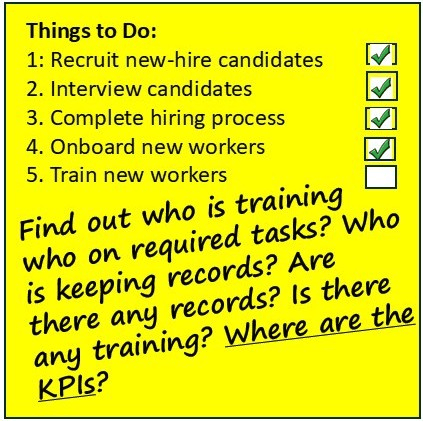 a comprehensive worker training infrastructure is not that difficult and only require a little more investment than the informal approach probably underway. It operates more cost-effectively and efficiently that the hodge-podge of efforts most employers struggle with. Most of the pieces are they and needs no additional staff. It only needs a proper assembly and alignment with the help of experienced technical support to transform it into a “system” and to “prime the pump.” Where practiced, the approach was easily assimilated into the company’s culture and without disruption to the existing order. In fact, the frequent reaction from some of the long-term incumbent employees has been, “why didn’t we do this sooner?”
You might recognize these challenges and have shed your fear of even looking for other solutions. Check out Proactive Technologies’ structured on-the-job training system approach to see how it might work at your firm, your family of facilities or your region, Contact a Proactive Technologies representative today to schedule a videoconference briefing to your computer. This can be followed up with an onsite presentation for you and your colleagues.

 Proactive Technologies, Inc.®; PROTECH®; Human Resource Management for Tomorrow...Today!® and logo; PROTECH©® System of Managed Human Resource Development™; Accelerated Transfer of Expertise System™; Certificate of Job Mastery Program™, Certificate of Task Mastery Program™ are all trademarks of Proactive Technologies Inc.®;